Swedese x Morakniv

An Homage to Craftsmanship
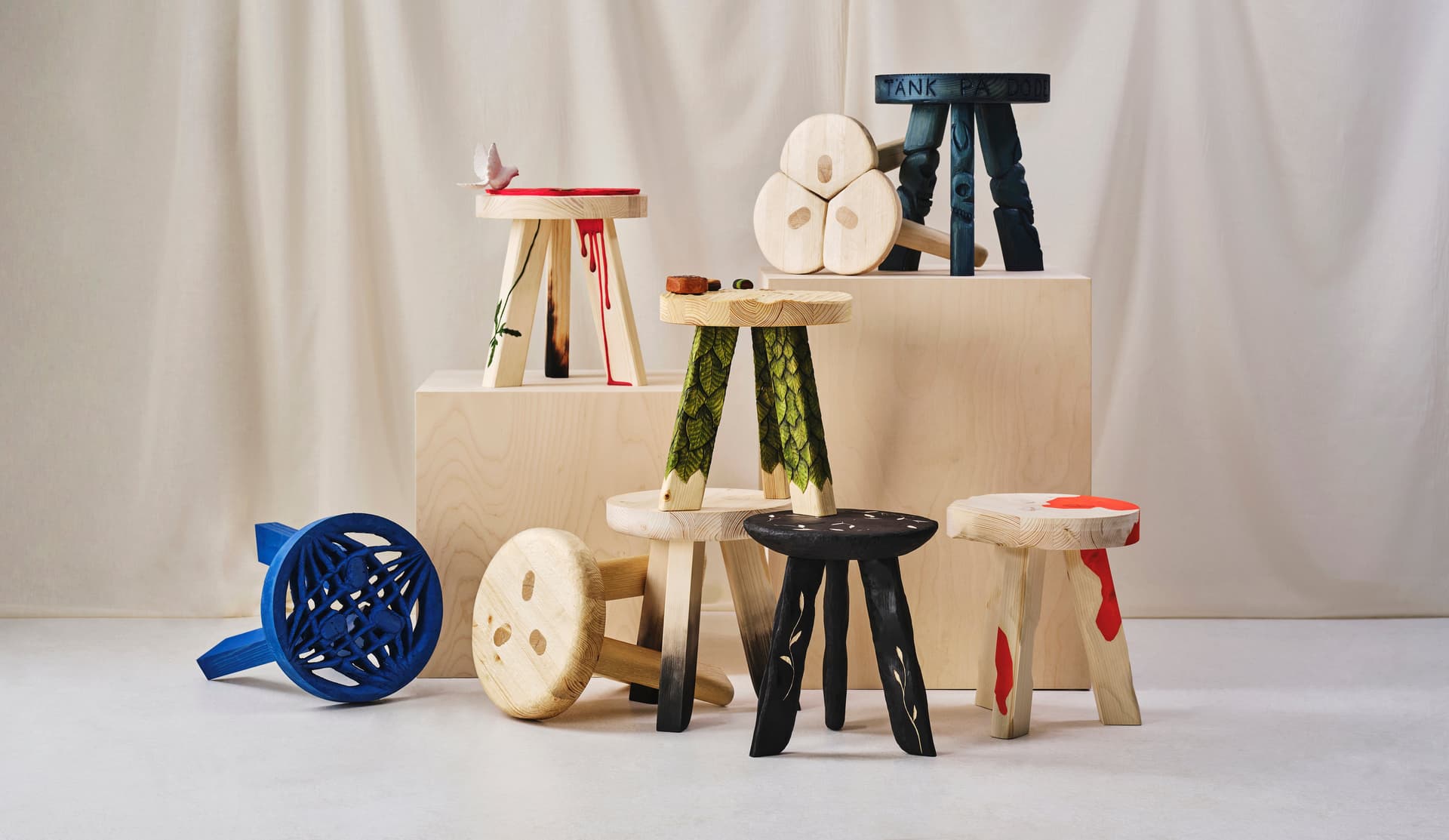
In a time when craftsmanship is often overlooked, we return to the essentials: a knife, a piece of wood, and hands that shape and create. Together, Swedese and Morakniv pay homage to craftsmanship—celebrating the creative process, the unique, and the legacy of making that is deeply rooted in our Småland factories.

Nine designers were invited to take on a challenge: using a carving knife, they were each asked to leave their mark on a wooden stool made from reclaimed construction wood. Some are craftspeople, others furniture designers, and a few work primarily in fashion. For some, it was their first time holding a carving knife.

There has been carving, sweating, shaping, and refining. The result is nine stools, nine expressions, and nine stories of craftsmanship—brought together in the exhibition An Homage to Craftsmanship.

February 3–5
The stools are launched during Stockholm Design Days.

February 13 – April 4
The exhibition An Homage to Craftsmanship is on view at Form/Design Center in Malmö.

April 15 – June 1
The exhibition is presented at Swedese in Vaggeryd.

June 13 – September 20
The stools are exhibited at Träart in Bodafors.

During the autumn, the exhibition will continue to tour across Sweden. The stools will later be auctioned in support of Vi-skogen.

The original stool

Louise Hederström

The starting point of this project was a simple stool—a piece of furniture found in every home, serving equally well as a seat or a table, as a functional object or a design statement. The original stool, placed in the hands of the nine designers, is made from spruce sourced from leftover construction wood. Its raw, unrefined form was designed by Louise Hederström, inviting each creator to carve out their own expression.

Palletik

Jenny Soddu

“I want, in my own way, to shed light on the horrific injustices taking place in the world—particularly in Palestine. I have worked with the colors and symbols of Palestine. A green poppy grows up along one leg and pushes through the seat, where a red flower blooms. On another leg, red blood runs; on the third, it has burned and turned black like coal. The white bird—the dove of peace—becomes essential, a light in the darkness, a hope for peace and freedom, all that remains.”

What do you think about the future of craftsmanship?
“I have to believe in the future of craftsmanship—there is no other option for me. Everything good that has happened in my life has involved different forms of craft and working with my hands, and I will do what I can to pass that on.”

Subdivision Modifier

Simon Mattisson

"Instead of using digital tools to create physical form, as in a typical design process, I used the digital tool as ornamentation. The expression and aesthetics of the computer program were allowed to merge with the craft of the hand and the nature of the wood."

How did your process unfold?
I began by creating a digital twin of the stool in CAD. I then applied a digital tool—a subdivision modifier—to the seat, which, simply put, turns square forms into rounded ones by adding more geometry. The tool creates a digital grid pattern on the surface, which I then transferred onto the wooden seat. I used the knife almost like a hoe or a spade, carving out the grid by hand."

Mitos

Roger Persson

“I decided early on to shape the seat based on the three legs, using three large circular forms that intersect. My inspiration comes from seed pods and cell division in the plant world. The idea is that the three circular forms should feel as though they are either coming together into a single shape or breaking apart into three.”

What was the most challenging part of the project?
“Working with the material—and learning to handle the knives—was of course a challenge. The most rewarding moment came when I finally felt the knife cut the way I wanted it to. Doing something entirely new for me, and returning to the stool again and again over the course of two months, slowly carving my way forward.”

Glimmer

Matilda Lindstam Nilsson

“I wanted to create both a visual and tactile softness in the legs—like a wave in motion. It also felt important for that softness to be reflected in the language of the seat. I wanted the rounded, somewhat bulky spruce seat to feel lighter. The pattern has been carved out by hand. The flowing lines become a quiet light against the raw, dark surface—it felt right to let the natural material beneath emerge.”

What do you think about the future of craftsmanship?
“I believe it will become more and more present. If we only dare to let go of the idea that everything has to be perfect. Perhaps it’s not about focusing on the result, but on the act of making. The mind thinks better thoughts when we work with our hands—away from all the screens.”

Fade

Rasmus Wingårdh

“The idea was to transform the stool’s original angular form using relatively simple means. I wanted to create something soft and more organic on the inside, while preserving its sharp edges and defined outer shape. In that way, I show respect for the stool’s origin—it remains hard and angular on the outside, yet soft and warm within.”
How did you achieve the ‘sooty’ finish?
“To create the sooty tone, inspired by charred wood, I used a Japanese ink diluted with water and soaked the legs in it. I then applied a more concentrated ink toward the base of the legs, allowing the color to gradually fade upward.”

STOOL — STOOL

Erik Nohlin

“The stool was once a simple, hard-working tool at the center of everyday life. Today, it is often a design object where signs of use are not meant to be visible. That’s why I carved a stool-stool—a functional object to sit or stand on, with a form so timeless it will remain just as unattractively attractive a hundred years from now.”

How did your process unfold?
“I’ve called the process anti-design design. How do I make both minimal and maximal intervention at the same time? I created a large radius template and carved until it fit. Each evening, I went out to the studio, put on a black metal record, and lost myself. Thousands of small knife movements eventually left a lasting impression.”

The leafy pastry

Molly Sjöstam

“I like the idea of allowing the tree—once felled to be worked by hand—to continue living, to grow and flourish. The conifer the stool is made from, together with the carved leaves—which for me symbolize the forest’s deciduous trees—are allowed to exist side by side, just as they always have in a mixed forest. Pack a picnic, find a clearing in the woods, pause for a moment, and enjoy the stillness.”
What was it like working with this type of wood?
“Just like in human relationships, it sometimes takes time to get to know someone and understand how they work. The same goes for getting acquainted with a new type of wood—something I truly experienced in this project. Compromise and acceptance became recurring themes during my time with the stool.”

Blood Orange

Louise Hederström

"How do you find your own visual language in a process you don’t fully master? That was truly the challenge in this project. It was carved entirely with Morakniv knives, which—together with the material and my limited carving experience—helped guide the way. How can carving itself become part of the stool, an abstract pattern that connects back to the original forms found in nature? From tree to stool to nature again. The color probably reflects both frustration and joy—of working with your hands, and of how unexpected tones appear in nature.”

Was the knife your friend or your enemy?
“It was more like an intense friend—fun to hang out with, but not for too long. You need to take a break now and then in order not to lose your edge.”

Think about death

Maria (Erixon) Levin

“Living in Gothenburg, you can read this on your way to primary school: ‘Think about death’ is written above the gate to the cemetery. Beautiful and direct. Death should be as natural as birth, and part of life. This became once again clear when a close friend passed away in late summer.”
How did you manage to create the skulls on the stool legs?
“I sketched the legs and approached them as if they were a technical drawing. This is the first time I’ve carved anything other than a barbecue stick in the forest.”

This is more than a design project. It is a story about the power of craftsmanship, the importance of sustainability, and the creativity of the future.