Our most commonly used materials
Materials for People and the Environment
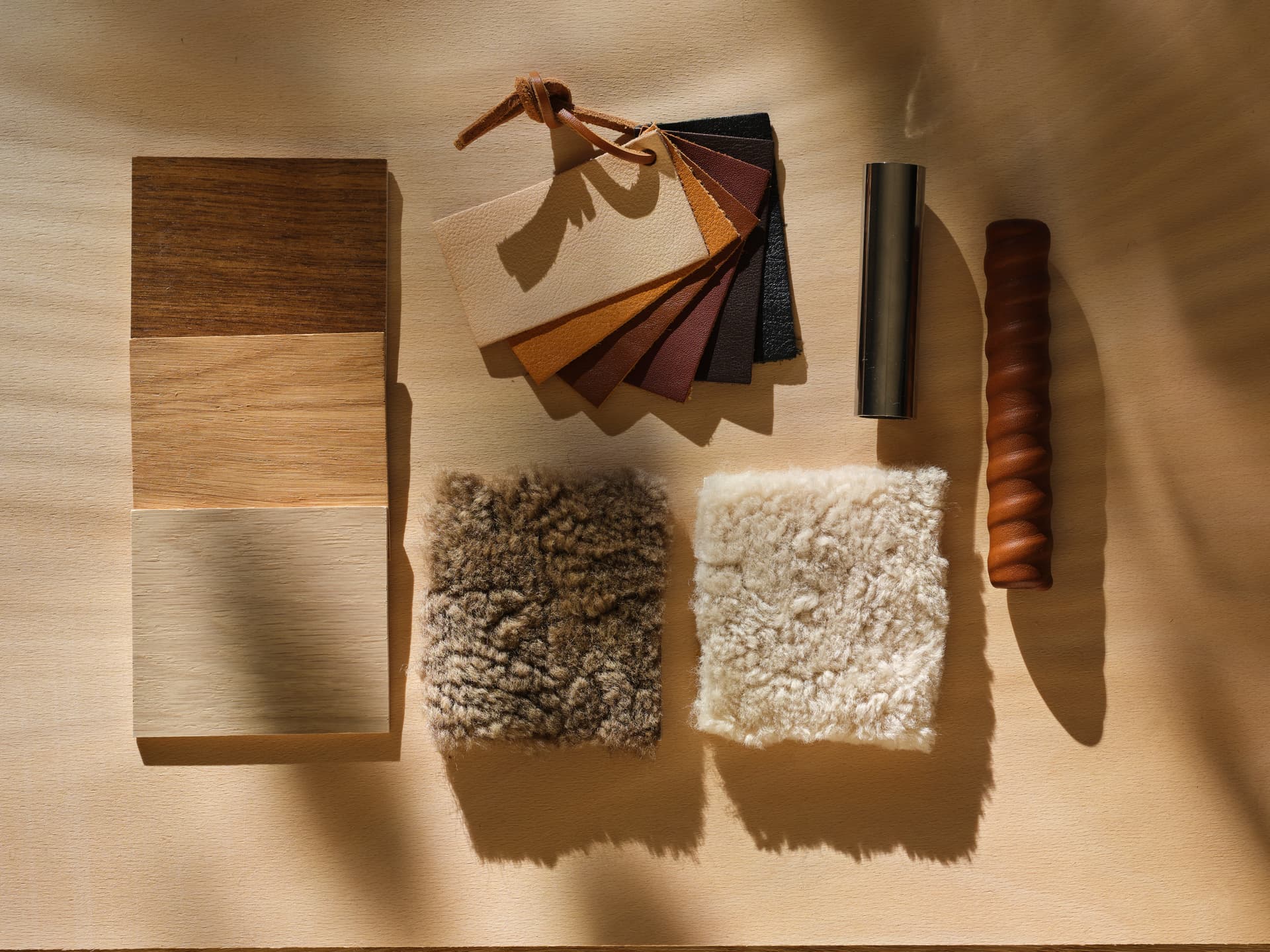
We continuously explore new materials and methods to design long-lasting furniture. Among all the materials we purchase, wood — in the form of solid components and veneer — represents the largest share.
WOOD – 39%
Wood, in the form of solid components and veneer, is our most widely used material. Veneer in beech and oak is sourced from northern Germany, birch from Finland, and ash from the Czech Republic. Currently, there are no sawmills in Sweden producing rotary-cut veneer.
Since 2013, all wood used in our own production has been certified and sourced from responsibly managed forests in accordance with FSC or PEFC standards. Over the years, the share of certified wood has ranged between 96–98%.
Wood components include structural elements such as sofa frames and legs, as well as finished wooden products from our suppliers.
SHEEPSKIN – 18%
All sheepskin is a by-product of meat and wool production, with a small portion coming from Gotland sheep in Sweden. The majority of our sheepskin originates from Australia and New Zealand.
FABRIC – 10%
Our main fabric suppliers are based in Europe, using raw materials primarily consisting of wool and recycled polyester. We actively work to avoid materials containing biocides and encourage our customers to choose textiles certified with the EU Ecolabel or OEKO-TEX.
POLYETHER – 10%
Used for upholstery, polyurethane foam may be cut (e.g. seat cushions) or moulded (e.g. Stella, Amstelle, and Pillo). Foam supplied by BPI and Letbæk includes a proportion of biomass.
Biomass can be compared to green electricity, where approximately 15% of the material is derived from food waste. Around 30% of our total polyurethane purchases (by value) consist of biomass-balanced foam.
STEEL – 9%
Steel and metal are primarily used for bases in sofas, armchairs, and tables. Our suppliers are mainly located in Småland and primarily use Swedish steel from SSAB.
PACKAGING – 5%
Packaging consists of FSC-certified corrugated cardboard for finished products, as well as wooden packaging and pallets for transport. We design our packaging to optimise transport efficiency and minimise damage during shipping.
ADHESIVE & LACQUER – 3%
Adhesives are used in veneer pressing, bonding foam to wooden frames, and attaching sheepskin to fabric. We have actively worked to replace adhesives with water-based alternatives with low formaldehyde content.
Since 2014, we have used water-based adhesives for frame assembly, and since 2016, formaldehyde-free adhesives for veneer pressing. Lacquers used for wood finishing are predominantly water-based.
Our goal is to completely phase out acid-based products by 2025 and rely solely on water-based alternatives. Currently, the distribution is 90% water-based and 10% solvent-based lacquer. Exceptions are made upon customer request for high-wear environments or where frequent disinfection is required, such as hospitals and restaurants.
LEATHER – 2%
Leather is used to a decreasing extent, primarily in public environments. Approximately 98% is Swedish leather sourced from Elmo or Tärnsjö.
ALUMINUM – 1%
Aluminium is used for armchair bases and consists of 97% recycled material.
OTHER MATERIALS – 3%
This category includes smaller components such as fasteners, sewing thread, castors, plastic fittings, and mirror glass.


